
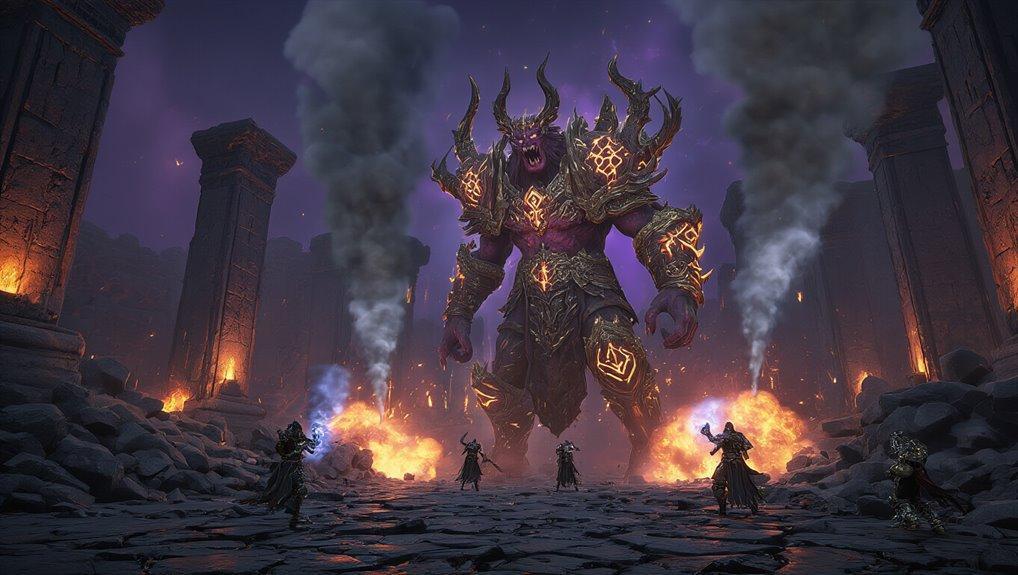

Mythic difficulty doesn’t simply inflate numbers on classic TBC encounters — it rebuilds their mechanical structure entirely. You’re facing compressed pacing, new ability phases, and positional requirements that punish memorized patterns. Encounters like Magtheridon demand synchronized execution with zero margin for error, while Gruul’s scaling mechanics become raid-ending fast. It’s adaptive strategy, not raw throughput, that defines your progression. What follows breaks down exactly how each encounter’s redesign changes what your raid must do to survive.
What Mythic Difficulty Actually Changes in Reworked TBC Encounters
When Blizzard reworks a TBC encounter for wow quel’danas mythic boost, the changes go well beyond raw stat inflation. You’re dealing with mechanical enhancements that fundamentally alter how abilities function, interact, and sequence. Spells that previously had predictable windows now overlap or accelerate, directly compressing encounter pacing and demanding tighter execution from your group.
You’ll notice these changes layer progressively. New phases get introduced, existing abilities gain secondary effects, and some mechanics become positionally dependent in ways they weren’t before. Each iteration builds on the last, requiring you to reassess rotational priorities and cooldown timing at every stage.
What makes Mythic reworks distinct isn’t just difficulty—it’s intentional redesign. Blizzard targets specific mechanical thresholds to push your coordination beyond memorized patterns. You can’t rely on baseline strategies; you need adaptive responses built through repeated attempts. Understanding these structural differences is the foundation for approaching any reworked TBC encounter effectively.
How Karazhan’s Bosses Were Completely Rebuilt for Mythic
Karazhan’s Mythic rework takes everything covered above and applies it at scale across a full instance, meaning you’re not adapting to one redesigned encounter—you’re managing cumulative mechanical pressure across twelve bosses that’ve each been rebuilt with distinct new logic. Karazhan Lore informs every redesign, with innovative mechanics tied directly to each boss’s narrative identity rather than arbitrarily layered difficulty.
|
Boss |
Key Mythic Change |
|
Attumen the Huntsman |
Phase transitions trigger enrage stacks |
|
Moroes |
Additional guests respawn on wipe recovery |
|
The Curator |
Flare management requires split positioning |
You’ll notice each change compounds your team’s decision-making load progressively. Attumen demands resource discipline early. Moroes penalizes poor cooldown timing. The Curator punishes positional laziness. By the time you’ve cleared mid-tier bosses, your group’s mechanical execution has been stress-tested across multiple layered systems, not just raw throughput.
Why Magtheridon and Gruul Are No Longer Farm Content
Once considered loot piñatas for overgeared groups, Magtheridon and Gruul have been fundamentally restructured under Mythic tuning to punish the exact habits that made them farmable in the first place.
Magtheridon mechanics now demand synchronized cube-clicking with zero margin for mistimed interrupts. Previously, you could brute-force through Blaze eruptions and collapse phases. Now, each failed click cascades into a raid-wiping chain reaction. You’re iterating on execution, not gear thresholds.
Gruul strategy has similarly shifted. His Shatter and Growth stacking patterns scale aggressively, eliminating passive tank survivability. You can’t ignore positioning anymore — incorrect spread distance now triggers overlapping Shatter damage that compounds exponentially per phase.
Both encounters now reward deliberate, disciplined play over raw throughput. You’ll notice that repetition builds mechanical literacy rather than complacency. These aren’t farm bosses anymore; they’re skill checks that expose coordination deficiencies your group previously masked with inflated item levels.
Overlooked TBC Mechanics That Become Lethal on Mythic
On Mythic difficulty, TBC’s often-ignored debuffs — like Magtheridon’s Blaze or Gruul’s Shatter — will kill you outright if you’re not actively tracking and cleansing them with precision. You’ll find that positioning errors you once survived through sheer healer output are now unrecoverable mistakes, as Mythic’s amplified damage scaling removes that safety net entirely. Enrage timers that once felt distant now demand you’ve optimized every damage cooldown, every rotation, and every pull sequence — or the encounter simply ends.
Overlooked Debuffs Turn Deadly
When scaling transforms TBC encounters into Mythic difficulty, debuffs that were once negligible become primary kill conditions. You’ll notice stacking mechanics that previously dealt minor chip damage now compound rapidly, creating lethal debuff synergy within seconds. A single missed dispel cascades into a wipe.
You need to audit every debuff applied during the encounter. Map their durations, stack thresholds, and interaction windows. Crowd control becomes essential not just for enemy management, but for buying dispel cycles. Identify which debuffs share damage amplification interactions—these compound multiplicatively on Mythic, not additively.
Prioritize your dispel rotation the same way you’d prioritize interrupt assignments. Assign ownership to each debuff category. Iteratively refine your dispel timing through repeated pulls, treating each failure as diagnostic data rather than random variance.
Positioning Errors Punished Harder
Debuff management tightens your rotational discipline, but positioning failures will end pulls before debuffs even become relevant. On Mythic, hitbox overlaps, sightline breaks, and stacking violations punish imprecision instantly. You can’t rely on healer throughput absorbing your mistakes — it won’t.
Refine your positioning strategies by pre-mapping movement patterns before the pull begins. Identify fixed anchor points, designated collapse zones, and spread coordinates specific to each phase transition. Every role needs pre-assigned lanes; improvised movement creates chain reactions that wipe groups.
When an ability telegraphs movement, your response must be immediate and exact — not approximate. Half-measures during repositioning kill nearby players and reset your damage window. Practice deliberate, consistent footwork until correct positioning becomes automatic, not reactive.
Enrage Timers Become Unforgiving
Enrage timers that felt manageable on lower difficulties become absolute ceilings on Mythic — you either clear the DPS threshold or the encounter ends. Mythic enrage thresholds aren’t forgiving margins; they’re precise cutoffs calibrated against optimal group performance. You’ll need to audit your damage output per phase, identify where damage spikes occur, and align cooldown usage accordingly.
Every wasted global, every misplaced cooldown, every death that pulls a player offline compounds into a failed timer. You’re not just hitting a number — you’re maintaining sustained throughput across mechanics that actively punish your positioning and resource management simultaneously. Treat each enrage threshold as a design constraint, reverse-engineer your cooldown rotation against it, and eliminate inefficiencies iteratively until your damage curve consistently clears the window.
Which Classes and Roles These Mythic Encounters Actually Demand
Mythic-tuned TBC encounters don’t distribute class and role demand evenly—certain fights actively punish roster gaps while rewarding specific toolkit overlaps. You’ll notice class synergy matters immediately: stacking complementary buffs through careful buff management amplifies damage output beyond what individual tuning alone achieves. Healers must iterate their healing strategy per encounter phase, not per pull, adjusting cooldown sequencing as mechanics compound. Tank coordination becomes non-negotiable when threat ceilings tighten and positioning requirements split aggro across multiple vectors simultaneously.
You’re also accountable for utility importance in ways Normal never tested. Crowd control isn’t optional padding—it’s structural. Missing a hard CC role creates cascade failures that no amount of raw throughput compensates for. Role adaptability separates functional rosters from struggling ones; your hybrid specs need to flex mid-encounter rather than commit statically. Every role carries conditional weight here, and Mythic exposes every gap you’ve chosen to ignore.
The Hardest Reworked TBC Encounters Ranked by Mechanical Complexity
Once you’ve identified what your roster needs to bring, the next question is which encounters will punish gaps hardest—and ranking them by mechanical complexity gives you a priority framework for preparation.
Starting at the top, Kael’thas Sunstrider’s rework layers weapon management, add prioritization, and interrupt sequencing simultaneously—your encounter strategies must account for all three phases without overlap errors. Lady Vashj follows closely, demanding precise totem coordination and real-time target switching that exposes weak positioning discipline instantly.
Archimonde’s revised version introduces soul charge tracking alongside fear-chain management, compressing your reaction window significantly. Gruul’s rework amplifies shatter synchronization, making spacing mechanical challenges unforgiving at higher multipliers.
Magtheridon sits lower but still requires coordinated cube-clicking with zero margin for mistimed interrupts. Prioritize your preparation in this order, allocate practice time proportionally, and you’ll address the most punishing mechanical challenges before they collapse your progression attempts entirely.
How to Prepare Your Raid Group for Mythic TBC Difficulty
Before your raid group steps into Mythic TBC content, you’ll need to audit each member’s gear against the encounter-specific stat thresholds, prioritizing resistance, health pools, and throughput benchmarks that vanilla TBC tuning never demanded. You’ll want to map out role assignments with surgical precision, ensuring tanks, healers, and DPS are distributed to cover the reworked mechanical checkpoints without overlap or gaps. Once you’ve validated both gear floors and role coverage, you’re positioned to iterate on your strategy rather than lose attempts to preventable deficits.
Gear And Stat Requirements
Preparing your raid group for Mythic TBC difficulty starts with hitting specific gear thresholds that directly impact your ability to survive and execute mechanics. Gear optimization isn’t optional—it’s foundational. Prioritize stat priorities relevant to each role before stepping in.
- Tanks need 490+ defense, capped avoidance, and stamina stacking above base requirements.
- Healers must prioritize spell power and mana regeneration to sustain extended Mythic encounter phases.
- DPS should maximize hit rating first, then weapon damage or spell power depending on spec.
- All roles require resistance gear for specific encounters like Hydross or Leotheras.
You’ll want to audit every player’s gear systematically. Weak stat priorities from even one member create cascading failure points across the entire raid.
Team Role Assignments
Defining team role assignments before your first pull is what separates coordinated progression from repeated wipes. Each role carries layered responsibilities that you’ll need to iterate on as encounters evolve.
|
Role |
Primary Responsibility |
|
Tanks |
Tank responsibilities include threat cycling and debuff management |
|
Healers |
Healing strategies must account for movement coordination |
|
DPS |
Damage distribution and crowd control assignments |
|
Support |
Role synergy through encounter adaptation |
You’ll assign crowd control targets pre-pull, establish debuff management rotations, and define movement coordination pathways before engaging. Healing strategies must respond dynamically to damage distribution patterns across phases. Role synergy isn’t static—you’re continuously refining tank responsibilities, repositioning crowd control, and adapting every assignment as Mythic mechanics escalate encounter demands.
Frequently Asked Questions
Are Mythic TBC Encounters Available in Both Retail and Classic Versions?
You won’t find mythic accessibility in Classic TBC—it’s strictly a retail feature. Encounter balance differs significantly between versions, as Classic preserves original tuning while retail iteratively redesigns these fights with modern mythic mechanics.
How Long Does the Average Mythic TBC Raid Session Typically Last?
Like a marathon runner pacing themselves, you’ll find mythic TBC raid duration typically runs 3-4 hours. Your session dynamics shift constantly—you’re iterating through wipes, refining strategies, and pushing your team’s limits progressively.
Can Cross-Realm Groups Participate in Mythic TBC Difficulty Together?
Yes, you can’t form cross-realm collaboration groups for mythic difficulty mechanics in TBC content — you’re restricted to same-realm players, as mythic’s technical framework doesn’t support cross-realm grouping, unlike Normal or Heroic difficulties.
Do Mythic TBC Encounters Offer Exclusive Cosmetic Rewards Unavailable Elsewhere?
Over 60% of players chase exclusive rewards purely for cosmetic variety. Yes, you’ll find Mythic TBC encounters drop unique transmogs, mounts, and titles that aren’t obtainable elsewhere, making your progression distinctly rewarding and visually unmatched.
Was Player Feedback Considered When Designing Mythic TBC Encounter Changes?
Yes, your player opinions were integral to the design process. Developers iteratively analyzed community feedback, refining mechanical adjustments, tuning encounter difficulty, and implementing balance changes to ensure Mythic TBC fights felt both challenging and rewarding for you.