


The primary friction point for any creative agency attempting to integrate generative AI into a professional production pipeline is visual drift. In a single-asset project, a “one-off” high-quality generation is often enough to satisfy a brief. However, for a multi-channel campaign—spanning social media stills, digital out-of-home (DOOH) video, and display banners—the luxury of randomness disappears. If the protagonist’s facial structure changes by 15% between a portrait shot and an action sequence, or if their signature wardrobe shifts hues from navy to charcoal, the brand identity collapses.
For agencies, “close enough” is an expensive failure. Correcting these discrepancies in post-production through traditional retouching or frame-by-frame painting often negates the efficiency gains promised by AI tools. Moving from a discovery-oriented mindset, where creators simply “see what the model gives them,” to an execution mindset requires a structured approach to visual anchors. This involves treating models like Nano Banana as stable engines rather than slot machines, requiring a tactical understanding of how to lock in subjects, environments, and stylistic markers across a varied asset list.
The Production Reality of Generative Character Drift
In a traditional photoshoot, character consistency is a given. You hire the same model, use the same wardrobe, and shoot in the same location. In the generative space, every new prompt is a re-negotiation with a latent space that has no inherent memory of your previous “hire.” This is where most agency workflows stall. A team might generate a perfect “hero” image but find themselves unable to replicate that exact person in a different pose or setting for a secondary asset.
The hidden cost here is not just in the wasted credits or time; it is in the loss of trust with the client. When a creative director presents a mood board, the client expects the final delivery to honor those specific visual traits. If the AI model fluctuates—changing the bridge of a nose, the density of hair, or the specific texture of a fabric—the production team is forced into a cycle of “prompt-hacking” that rarely yields identical results. Transitioning to a professional-grade pipeline means moving toward a “seed-and-reference” model where the creator dictates the constants and allows the AI to vary only the context.
Fixed Subject Logic in Kimg AI Workflows
To solve for identity, production leads must move beyond natural language descriptions. While a prompt like “a professional woman in a tech office” is fine for a stock photo replacement, it is too broad for a campaign. Professional workflows using Nano Banana prioritize structural weight. This means identifying unique, non-negotiable physical markers that the model can latch onto across different iterations.
Instead of generic descriptors, effective prompts use specific, high-contrast anchors. For example, giving a character a very specific accessory—like “asymmetrical matte-black geometric glasses”—provides the model with a consistent geometric “hook.” Because the model is trained to recognize these distinct shapes, it is more likely to maintain the character’s facial geometry around that anchor point. Using Nano Banana AI in this way requires a disciplined hierarchy in your prompting. You lead with the persistent subject traits and follow with the variable environmental data.
However, there is a limit to how much a prompt alone can stabilize a character. Even with precise Nano Banana AI descriptors, the model may struggle with radical changes in composition. A character viewed from a 45-degree angle might look perfect, but a direct profile shot often introduces subtle “hallucinations” in the facial structure. At this stage, the process requires moving from pure text-to-image into an image-to-image (i2i) workflow. By using a “master” character sheet as a reference, creators can guide the model to maintain proportions that text descriptions simply cannot convey.
Bridging Image and Motion Without Losing Identity
The challenge of consistency doubles when moving from static imagery to motion. This is where many generative tools fail the agency test; the “flicker” effect is often just the model recalculating the character’s face 24 times per second with slight variations. Maintaining scene integrity requires a bridge between the initial design and the final motion output.
Using Banana AI as a foundational engine for these transitions allows teams to leverage image-to-video (I2V) pipelines. Instead of asking the AI to “generate a video of a woman drinking coffee,” the team first perfects the static image of the woman, the cup, and the lighting using Banana AI. This static image serves as the “ground truth.” When this image is then fed into a motion model, the AI isn’t guessing what the character looks like; it is calculating how that existing geometry should move through space.
Background stability is equally critical. In a professional campaign, the environment needs to feel like a real, persistent space. We have found that it is often more effective to generate a clean, wide-angle “plate” of the environment first. Once the environment is locked, the subject can be placed into it using varied generation layers. This prevents the “morphing background” syndrome where a bookshelf in the background turns into a window as the camera pans. However, it is important to reset expectations here: dynamic lighting shifts—such as a character walking from a dark hallway into bright sunlight—remain incredibly difficult to solve without significant manual compositing.
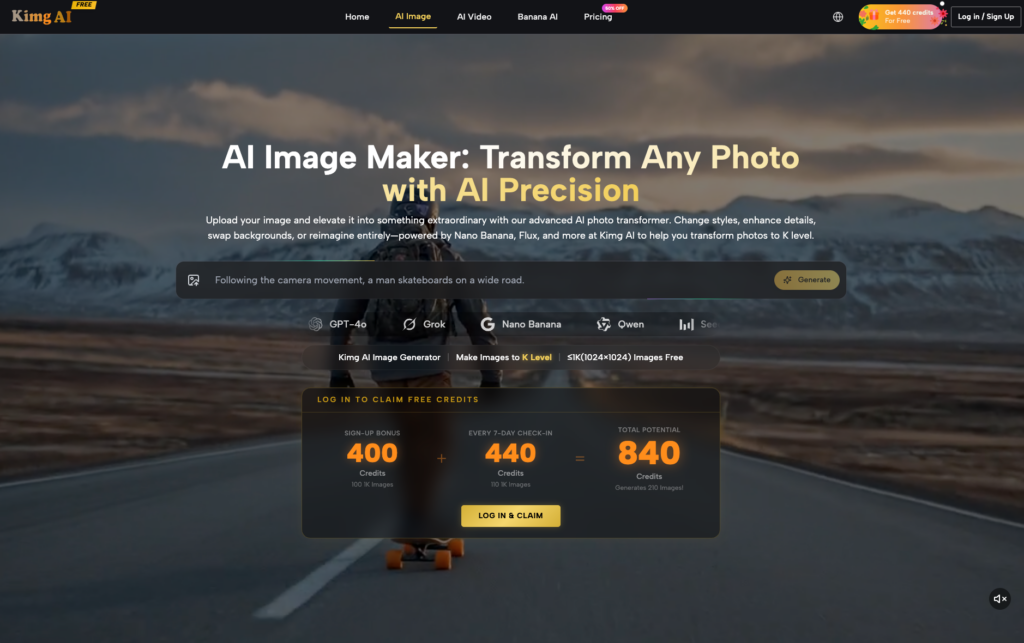
Scaling Production on the Kimg AI Engine
Consistency at scale requires more than just a good model; it requires a post-generation toolkit that can normalize varied outputs. This is where the Kimg AI platform provides a necessary layer of professional control. When a team generates 50 different assets, even under the best conditions, there will be “micro-drifts” in resolution, texture, and detail.
The first step in normalizing these assets is through the Kimg AI upscaling tools. Generating at a lower resolution and then upscaling to “K level” resolution ensures that the grain, sharpness, and pixel density are uniform across the entire campaign. If one image is generated with a different model or at a slightly different aspect ratio, the upscaler acts as a unifying filter.
Furthermore, the in-painting and editing tools on Kimg AI are vital for fixing character drift without needing to re-generate the entire frame. If a character’s eye color or a logo on their shirt shifts during a Nano Banana run, it is far more efficient to mask that specific area and use in-painting to “force” the correct detail back in. This hybrid approach—generative creation followed by AI-assisted surgical editing—is the only way to meet high-fidelity brand standards. By using these tools as a corrective layer, agencies can salvage “near-miss” generations that have the right energy but the wrong details.
Where Consistency Breaks Down: The Limits of Current Models
It is a mistake to promise clients that generative AI can currently handle every possible visual scenario with perfect fidelity. There are specific “break points” in the technology that every operator should be aware of. The most prominent is the “perspective shift” problem. If you have established a character in a medium-shot, and then attempt to generate that same character in an extreme bird’s-eye view, the Nano Banana model will often struggle to maintain the specific facial geometry. The shift in perspective is so radical that the latent space defaults to a “generic” version of that angle rather than a “subject-specific” version.
Another area of uncertainty is extreme lighting variance. While you can prompt for “neon lighting” or “golden hour,” maintaining the exact skin tone and eye color of a character across these two extremes is notoriously difficult. The way light interacts with surfaces in these models is often baked into the “style” of the generation, meaning the character’s identity can become subservient to the lighting effect.
Finally, human oversight remains a non-negotiable part of the pipeline. No matter how refined the Nano Banana AI prompt is, or how stable the Banana AI video output seems, a human editor must perform the final “identity check.” We are not yet at the stage of “set it and forget it” production. For agencies, the goal is not to remove the human from the loop, but to use the Kimg AI suite to ensure that the human spends their time on creative direction rather than fighting the tool for basic visual consistency. Success in this new medium is found in the balance between the model’s creative “dreaming” and the operator’s rigid structural constraints.